
Here and Now
Here & Now for October 16, 2026
Season 2500 Episode 2516 | 56m 45sVideo has Closed Captions
Watch the entire episode of Here & Now for October 16.
Watch the entire episode of Here & Now for October 16.
Problems playing video? | Closed Captioning Feedback
Problems playing video? | Closed Captioning Feedback
Here and Now is a local public television program presented by PBS Wisconsin
Here and Now
Here & Now for October 16, 2026
Season 2500 Episode 2516 | 56m 45sVideo has Closed Captions
Watch the entire episode of Here & Now for October 16.
Problems playing video? | Closed Captioning Feedback
Where to Watch Here and Now
Here and Now is available to stream on pbs.org and the PBS app.
Providing Support for PBS.org
Learn Moreabout PBS online sponsorship>> The following program is a PBS Wisconsin Original production.
>> This program is part of our "Here& Now".
2026 Election Coverage.
[MUSIC] approach and voters get serious about how they'll cast their ballot, their choice of candidates, and what issues matter most.
I'm Frederica Freyberg.
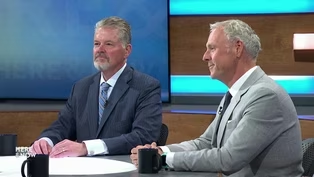
Tonight on "Here& Now", a one hour election special with commentary from our political panelists, Bill McCoshen and Scot Ross.
Where the candidates for governor stand on election conspiracies and the top issues in the race for Attorney General.
What advice clerks and officials give voters ahead of Election Day?
Explanations of the proposed constitutional amendments on the ballot, and more.
It's "Here& Now" for October 16th.
>> Funding for "Here& Now" is provided by the Focus Fund for journalism and Friends of PBS Wisconsin.
>> Everybody is talking about it with bated breath.
With just over two weeks until Election Day.
Will the midterms be a Democratic wave or a whimper?
Will the Wisconsin legislature flip, or will Republicans maintain control?
We put these questions and more to our political panelists.
Republican Bill McCoshen and Democrat Scot Ross.
Thanks for being here.
>> Thanks for having us.
>> So I want to start out by quoting Chuck Schumer, who asked this will the unprecedented tsunami of Republican money defeat the massive Democratic advantage in political climate?
Do you think it will, both at that level and across Wisconsin?
>> We don't have a we don't have a Senate race here in Wisconsin.
But it's very clear that the minority leader is looking at Wisconsin because what we basically have is three billionaires versus 3.7 million voters.
The investment by Diane Hendrix and the U. Lines, Dick and Liz is.
It's unfathomable.
They have put something in the neighborhood of $50 million into direct campaign contributions by funneling through the Democrat or through the Republican Party to not just Tom Tiffany, but also the state Senate and the state Assembly.
They are they represent 90% of the fundraising by Tom Tiffany and every single candidate in the state, state legislature for the Republicans.
>> So, Bill, do you think this will mean a win?
>> It's kept Republicans in the game for sure, particularly Tom Tiffany.
He's defying gravity political gravity right now.
It's a good year for Democrats.
No question about that.
Will it be a great year?
It remains to be seen.
I you know, is it a red undertone where people are just fed up with broken promises that particularly on the Iran war?
Or will it be a blue wave?
The polling says voters are not very happy with Democrats either.
So midterms generally go against the party in the white House.
That's Republicans this time around.
But I think there'll be some surprises across the board.
>> What's your gut and info on Blue wave or no blue wave?
>> Oh, I mean, this election is about two things.
It is about costs and it is about corruption.
And the Republicans on both have failed us.
Prices are through the roof on gas, groceries.
People can't buy homes.
Meanwhile, the corruption that you see coming out of Washington, D.C.
and here in the state of Wisconsin with Donald Trump and, you know, the the $2 billion for January 6th, terrorist insurrectionists he tried Tom Tiffany's voted with him 100% of the time, that Tom Tiffany can't point a single thing that he disagrees with with Donald Trump on except, sorry, the renaming of Lake Ontario.
That's the only thing he has disagreed with Trump on.
And that's why Republicans, since he's leading ticket, are going to wash him, wash them out.
back a little bit from some of what Trump has said and done.
Tom, Tiffany, how hard is that for him to to run this line?
>> I think he's seeing candidates across the country, depending on what the climate is in their particular state, taking similar positions.
Ashley Hinson in Iowa would be another good example, but I think Tiffany's done a pretty good job of walking this line.
Let's not forget Donald Trump got more votes in the state of Wisconsin than any statewide candidate in history.
Roughly 1.7 million.
The only one who has come close to him was Barack Obama in 2008.
There won't be 3 million plus voters in a in a midterm election.
It will be probably around 2.7 million means.
Tom Tiffany needs 1.3, 1.34 somewhere in that neighborhood to win.
And I would tell you, he has the best grassroots organization I've ever seen built in the state of Wisconsin on either side.
So I think there's an opportunity here for Tom Tiffany to overcome all the obstacles and still win.
>> How does David Crowley overcome the obstacle of the money imbalance?
>> Well, the thing is, is that David Crowley is remaining competitive with fundraising.
And I think that the fact that three billionaires are trying to finance this race for Tom Tiffany has drawn out national fundraising and in-state fundraising.
I think he is definitely closing the gap.
But when you have three people who can write checks because you're willing to deliver for them, the biggest tax cuts in world history, when you're able to cut taxes in the in the state legislature, as he did in order, you know, and fund that for them by making the largest cuts to public education in state history.
That's where you're on the wrong side of things.
You know, listen, bring Donald Trump here.
If Donald Trump got the most votes ever in 2024, you bring him here, we'd be.
>> Pumped for your for your viewers 2015 act 117 allowed for unlimited contributions to go directly to parties that then can be transferred to candidates.
Democrats have used this tool for ten years.
Very successfully.
>> They bought Tom Tiffany.
>> They bought the Supreme Court.
They now had the majority on the Supreme Court using that loophole.
>> All right, let's move to the legislature.
What do you think is going to happen there?
>> I think Democrats have a pretty good shot to flip the majority in the Senate.
It's they need three out of four seats to get there.
They've got good candidates.
They're running good campaigns.
They started early, which is a recipe for success.
But I think the Republicans hang on in the Assembly.
They probably lose a couple of seats.
They have five to give to lose the majority.
But I think they hold on.
And part of it is they've got a significant money advantage.
They've got great candidates, and in most cases they've got incumbents running.
And it's always tough to beat an incumbent.
>> There's that money again.
But what do you think about what's going to happen in the legislature?
gone.
I mean, they've all but given up.
For instance, on the on the fifth Senate district, which was always a battleground district if it wasn't controlled by Republicans, it was a battleground.
But here's the thing.
These are the second you know, the second elections we're having with actual fair maps.
And we saw the unprecedented wave that that Democrats had in 2024 in a in a place where Donald Trump got the most votes in history with these fair maps, with the environment being so bad for Republicans because of their failures up and down the up and down the stream.
This is I think it's going to be a big night for Democrats here in the state of Wisconsin.
You know, again, you're seeing races where 90% of the money for the Republicans is coming out of out of.
Diane Hendrix, Liz Uihlein and Dick Ullin's wallets.
You know, this is the most it's the most unproductive legislature ever that we've ever had.
And they're too lazy to even raise money off of people, you know, building that grassroots.
>> Support.
>> Building that grassroots support is about moving people up to volunteer ladder.
You look on the Democratic side, you see candidates with 50, $2,500 donations from people in the district.
You see none of that from Republicans.
>> Part of what's driving the money is Democrats talking about a trifecta that is driving donors on our side to contribute to the Assembly, in particular, because they view them as the goalie, the place where they can stop the trifecta.
So I think the more you talk about a trifecta, the more money we're going to be able to raise on this.
>> I am not using the T word, but I will say is this is that since Tom Tiffany was in the legislature, since he was a state senator for Dick, and Liz Uihlein properties up in Manitowish waters, he has been in the tank for them.
They have a 12 year long relationship.
It's why they have chosen not to create their own independent groups, but to give that money directly through the party.
With the loophole authored by Tom Tiffany back in 2015.
>> I want to ask you, Bill, why the national Republicans are putting money into Bryan Steil in the first.
>> Well, because Democrats are coming after him.
And part of that has to do more with 2028 than it has to do with 2026.
Bryan Steil is a leader on the Republican side in the Congress.
He's raised $7 million.
He's a hard worker.
He's back in the district all the time, working from Kenosha to to Janesville, his hometown.
Democrats view him as a threat in 2028 for a U.S.
Senate seat.
If Ron Johnson decides not to seek reelection.
So they're trying to take Bryan Steil out this cycle.
>> Well, I think what's happened is that the party, the powers that be on Bill's side out in D.C.
have been reading Derrick Van Norton's tweets and are like, we this guy's going down.
We're going to try and save.
We're going to try and save Bryan Steil, who, incidentally, was under the fundraising that Mitchell Berman has.
His his opponent had.
And according to the polling that's out there, Mitchell Berman is currently ahead in this race, which is was unimaginable a year, a year and a half ago.
>> He's not ahead.
Bryan Steil is going to win.
>> All right.
We'll we'll find out.
Bill McCoshen Scot Ross, thanks so much.
Donald Trump is not on the ballot this fall, but he is still trying to shape the outcome of the election, not only through campaigning but through executive orders that would dramatically reshape how we vote and who can vote "Here& Now".
Senior political reporter Zac Schultz has more on how Wisconsin's candidates for office are responding to these efforts.
>> On January 6th, 2021, Republican Congressman Tom Tiffany was in the U.S.
Capitol as Congress prepared to certify the electoral votes that showed Joe Biden had won the presidential election.
Tiffany voted against certifying the results from Pennsylvania and Arizona, part of a Trump plan to invalidate the election.
Outside, a violent mob egged on by Trump himself, stormed the Capitol, forcing lawmakers to seek safety.
Eventually, order was restored and Congress certified the election.
Nearly six years later.
The lies about rampant voter fraud and rigged elections still circulate, pushed by Trump himself at a rally in Eau Claire last June.
>> They rigged the election.
When I turned, the election was totally rigged.
It was.
>> Trump's grievances over 2020 led to efforts by his administration to have the federal government take over elections and authority.
Congress has delegated to the states.
First, he demanded states hand over voting lists, including confidential data like Social Security numbers.
Wisconsin, like many states, refused.
Republicans in Congress tried to pass the Save Act, which would create a proof of citizenship requirement so strict that critics estimated millions of legal voters would not be able to meet it.
That bill passed the House with Tiffany's support, but stalled in the Senate.
In March, Trump issued an executive order that would have required the U.S.
Postal Service to create a list of which voters were eligible to send an absentee ballot through the mail, a process that would have disenfranchized millions of voters.
>> Also, the ballots, the voting, the mail in ballots so crooked they send millions of ballots out all over the place.
If you're a Democrat, sometimes you get 6 or 7.
>> Wisconsins Democratic Attorney General Josh Kaul joined a lawsuit that fought that order, something he sees as a key point in his election against Republican Eric Toney.
>> What I think is fundamental and a big difference between Democratic AG in this office and a Republican AG is, are we going to stand up for the rights of the people of our state?
Are we standing up for the interests of the people of the state, or are we just going to cave to the Trump administration on issue the matter is Eric Toney would not stand up to the Trump administration the way I have.
It wouldn't even be close.
>> Across the country.
Zero Republican attorneys general joined that lawsuit.
We asked Eric Toney if he would have joined the case.
So yes or no.
Would you have Wisconsin be a part of this case against the Postal Service rules?
>> So what I can say is I would be defending the ability for people to vote early.
And one of the things I've been very careful on, I rarely comment on the different lawsuits that are out there, because I want to make sure we're working with the great attorneys that we have at our Department of Justice, making these decisions based on the facts and the law.
And if in that conversation, we believe that that's unconstitutional, I would absolutely join a lawsuit like that to make sure that we're protecting people's rights to vote early here in Wisconsin.
>> We interviewed gubernatorial candidates Tom Tiffany and David Crowley as the country was waiting for the U.S.
Supreme Court to decide if the rule could move forward.
Tiffany would not say if he supported the rule change.
>> I mean, that's going to be up to the courts.
It is in the courts at this point, and they're going to decide what role is going to be able to be played there.
All I know is I have confidence in clerks across the state of Wisconsin.
There's hundreds of them, and I've worked with them in northern Wisconsin.
Regardless of what rules are put before them, they always go out and do their job.
And I appreciate the work that they do.
>> Crowley says.
That fits a larger pattern for Tiffany.
>> As the governor, it is our job to make sure that we are protecting democracy, protecting people's ability to cast their ballot and to, to, to instill dignity.
Right?
We have free and fair elections here in the state of Wisconsin, and I'm always going to sing and yell at the mountaintops about how I believe in our election system.
But you're not going to get that with Congressman Tom Tiffany.
I mean, we're talking about someone who voted against certifying the 2020 election for Wisconsin voters, someone who's not willing to stand up and say Donald Trump actually lost the 2020 election.
>> The website Election deniers.org tracks candidates for office that voted against certifying election results or spread conspiracies about election fraud.
They list Tom Tiffany, citing his votes on January 6th, 2021.
Tiffany denies being an election denier.
Do you have complete confidence that our elections in Wisconsin are free and fair and legitimate?
>> I believe that our elections are going to be done in that fashion.
I mean, it should be easy to vote, but hard to cheat.
Now, there's been a couple instances.
You look at Madison, they had the city of Madison had to fire their clerk two years ago because she failed to count 197 ballots.
Green Bay has had a problem.
Two elections in a row with their clerk.
I mean, we have to be vigilant also, but I just know the hundreds of clerks across the state of Wisconsin.
They do the very best job that they can.
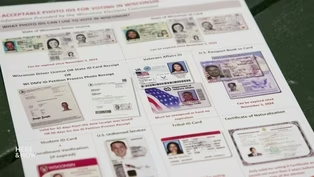
>> Outside the specter of election conspiracies about voter fraud or concerns about a federal takeover of elections.
Both candidates encourage voters to have a plan to vote.
>> Go out and get your ballot in, because we know that the mail us mail is not what it used to be.
I mean, it's a number of years ago that our U.S.
mail service has been in decline.
So make sure you figure out how you're going to vote.
And remember, at two weeks before the election, you can go vote in person.
So that is an option also.
>> But I want to encourage everybody.
1 if you're going to mail in your ballot, do it early, do it quickly, and do it as soon as possible.
And if you feel like you're getting close to that deadline, go visit your municipal clerk and drop that.
Drop your ballot off at your at your clerk to make sure that your voice is being heard.
>> Reporting from Madison.
I'm Zac Schultz for Here and Now.
>> Election clerks across the state are at their busiest, preparing for November 3rd in person absentee voting that begins Tuesday is expected to see a high turnout as confidence among voters and election officials in the Postal Service to deliver mail in ballots on time is at a low.
>> The trend of fewer absentee ballots is true across the whole county, not just Madison.
And we are getting an influx of phone calls.
We're asking about in-person absentee hours.
So I think we'll see.
This has been a trend in the last few years where the trends of Madison are pretty much mirrored across the whole county.
So we'll see an increase in in-person absentee voting across across the county starting next week.
I want to point out, though, that each community has its own hours.
Some have dropboxes, some do not.
I think one of the problem with this general messaging is people get confused because each community is different.
So really you need to check, you know, my vote to see the status.
You can call that your clerk's office to find out when they're there.
If you want to hand deliver a ballot or do in-person absentee hours leading up to the election, voters should get their ballot in two weeks out.
And I agree that while that's a long time, we were seeing ballots show up with postmarks longer than that.
So I think once you get inside that two weeks, if you can hand deliver it to a drop box or to a clerk's office, that would be our recommendation.
>> As messages from the federal level say there is massive voter fraud.
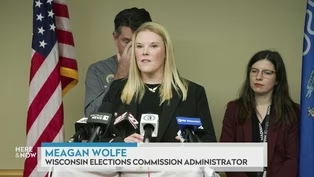
The Wisconsin Elections upon voters that the midterms will be safe and secure.
>> No one can ever prepare for the exact scenarios they may encounter, but our election officials take it very seriously to lay the groundwork to support any contingencies that might come our way at the state and local level.
We've also keeping pace with changing, with the changing cybersecurity environment to ensure that election systems and voter data are secured and protected.
Our poll books around the state are painstakingly updated by each of our clerks to ensure that voter lists are as accurate and up to date as possible, and that only lawful registered voters appear on each poll list.
I think that as a swing states and as a battleground, states in elections, Wisconsin is used to having a lot of observers and attention.
So having observers from congressional offices, from U.S.
DOJ.
This is not abnormal.
This is a normal part of Wisconsin elections that those folks come to observe.
And the law does not allow voter intimidation.
There are federal laws that prohibit armed federal officers from being at the polls.
And so we expect everything to be conducted in accordance with the law.
We have not heard anything that suggests that there will be anything outside of that.
But certainly we have a well established structure for getting information from the local officials and for working with our legal structure in order to address anything that might come our way.
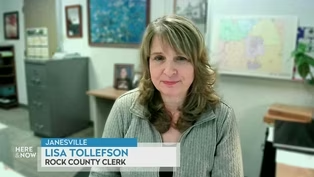
>> Adding to the stew of misinformation, our election scams, including fake registration mailers, websites mimicking official government sites and AI generated content on social media, election officials like Rock County Clerk Lisa Tollefson want to be a backstop for accurate information to the public.
She joined us earlier.
Thanks so much for joining us.
>> Thank you for having me.
>> So the Wisconsin Elections Commission has warned about voting and election scams, everything from fake polling to kind of bogus third party mailings of registration forms.
What have you seen out there this year?
>> I have seen people have received those very vague, very unprofessional looking voter registration forms.
Your clerks not sending those to you, even though the return address might be your clerk.
If you want to register, you can go on to myvote.wi.gov or go to your clerk's office or register at the polls on Election Day.
you have, if any, about any election interference on or after November 3rd?
>> I'm not concerned as much about that.
I'm more concerned about getting the election, getting everything done and ready.
Our elections are very secure.
We have checks and balances all the way through the system.
We have a paper backup of every ballot.
I don't see that happening because we have so many things in place already to protect it.
Some of the things that I think are, are a little more concerning are when you see things on social media.
There's so much AI, there's it's kind of hard for voters to figure out what's real and what's not.
Sometimes because it's changed so much since the last governor's race, I've heard that there are more fake websites that are trying to be news outlets to get out information.
That concerns me, because not everybody looks at the website address or knows to even think about that.
And then we have the chat bots that when you do a search, can sometimes give you general information, but it might not quite be accurate.
So there's, there's so many different things that are playing on getting information.
Now that's harder for voters.
I recommend if it's on how voting works, go to my vote.w.gov or check with your municipal clerks or county clerks.
Don't be afraid to call and ask us questions.
That's hugely important.
We're going to tell you the process, and especially for Wisconsin, our laws are not the same as the voting laws in other states.
So in Wisconsin, the ballots got to be back by 8 p.m.
on election night, or we don't count it.
Other states they have, they can go by postmark in Wisconsin.
We don't.
But check the.
If if something seems.
It's a little off, it probably is.
You might want to research it before you jump in and look at it.
And it's.
It's really tough is when a misinformation gets out there, it spreads like wildfire.
And the correction.
To fix it afterwards is always a whole lot slower.
>> Have you had voters directly reach out to your office to verify accurate information?
>> We often do, and the sometimes polling places change.
And again, we get them the right place.
The clerks always are willing to help anybody find their polling location or answer questions.
>> What's new for this election around rules or guidance?
>> So there's no change to the rules on absentee voting.
So you can mail your there's no checking the rules that we're going to be put in place or tried to be put in place, did not go into place through the executive orders.
So absentee ballots, that all stays the same.
One thing that we are pushing is that if you are going to mail back your absentee ballot, mail it back at least 14 days before the election, we have found some delayed time frames for ballots being returned.
Think ahead.
If you're if you have your ballot and you're closer to the election, you might want to deliver it yourself to your clerk or a drop box.
I'm concerned that the mail is going to be delayed.
They try really hard, but I'm.
It's the last two cycles in August and April, we saw absentee ballots coming back after Election Day, and there's nothing we can do about it.
>> Have you seen an uptick or a decrease in absentee ballots being returned to you this year?
>> I'm hearing from the municipal clerks.
It's a little lower than in past elections.
I have a feeling that when in-person voting starts, that that will be heavier.
>> What do you expect in terms of turnout?
>> Oh, that's always a tough one.
I actually suspect it will be quite high, probably comparable or higher than the last governor's race.
>> And why do you have that suspicion?
>> I tend to look at the number of questions I'm getting.
The number of signs everywhere tends to give me an idea of how energized people are to vote.
And I'm seeing similar, but I'm actually seeing it earlier.
So that's why I'm thinking that it'll be a little higher than the last governor's race.
>> Well, we wish you luck with that.
If that turnout proves and we will check back in with you following Election Day.
Lisa Tollefson Rock County Clerk thanks so much.
>> Thank you.
>> Every four years, the race for attorney general in Wisconsin gets overshadowed by the attention paid to the race for governor.
But the attorney General's office is extremely important.
With the control of the Department of Justice and the ability to represent the state in lawsuits in both state and federal courts.
Here and now, senior political reporter Zac Schultz sat down with each of the candidates.
You can see those longer interviews on our website.
But this week, we look at the key issues.
Each of the candidates wants voters to focus on when they fill out their ballot.
>> All right.
Good morning everybody.
Thank you for being here.
I'm Josh Kaul, and I'm here to talk about my reelection campaign for attorney General.
>> Good morning.
Great to be with everybody.
I am running for Attorney general.
>> Democrat Josh call and Republican Eric Toni are no strangers to running against each other for attorney general.
This election is a rematch of the 2022 race, where Kaul narrowly defeated Toni.
It's not often that we see a rematch in statewide elections, but Toni says a mini stroke and open heart surgery in 2023 made him want to run again.
>> I was starting to think about what do I want to continue to do if this surgery goes well?
But I was at that point just trusting God through the hands of my medical team that hoping and praying things would go well and I, as it got closer, knew that I would want to run again.
>> Kohl says the rematch should make it >> Easy for the voters.
>> One of the things that's interesting about a rematch is you can look back at what the candidates said in the prior race and see how those things held up.
And I think that that's really instructive here.
In the last campaign, it was shortly after Roe v Wade had been I had filed a lawsuit seeking to block enforcement of a law that dates back to the mid 1800s.
Eric Toney my opponent had attacked me for that case.
He called it a partisan partisan stunt.
He said it was should be dismissed.
>> The Liberal majority on the Wisconsin Supreme Court agreed with Kohl and overturned the 1849 abortion law.
A 20 week limitation that was already on the books is now the law in Wisconsin.
Toni says he would not seek to change that.
>> I have not and am not advocating for any changes to the law in Wisconsin.
And if there is going to be any change, that's something that needs to be voted on by the people of Wisconsin and not decided on by politicians in Madison.
>> Toni says the issue voters need to look at from the last four years is the crime lab.
After his close loss in 2022, Toni joined Kohl in the spring of 2023 to push the Republican controlled legislature to fund 16 more positions at the state crime lab.
>> I've always talked about putting public safety over politics.
I stood with our attorney general after that 2022 race, helping him get more crime lab positions in that state budget, working with Republican legislators behind the scenes.
>> The legislature approved just three of the 16 positions.
None of them for DNA analysis in the 25 budget call.
Tried again to lobby for more positions.
>> In the upcoming state budget.
In particular, we've requested 19 positions.
finance gave them zero.
Toni says the lack of investment doesn't matter.
>> What we saw our attorney general do during this period is put a hiring freeze in place.
And so I mentioned those crime lab positions.
I helped him get.
Well, over a year later, we saw a nonpartisan audit released of our crime labs, and they said he hadn't even filled those positions.
We saw that he had less DNA positions filled compared to 2020.
And we see that they're taking for DNA, for example, taking on average over twice as long to test less from when he started to where we are now.
>> Now, in terms of the labs themselves, on a day to day basis, one of the things I've been clear about is where we need resources from the state legislature.
And in the last state budget, my office requested 19 additional positions for the labs.
Eric Toney as allies in the state legislature provided zero positions.
And look, that's not an accident.
This is politics being played here.
>> Toni accuses Kohl of overlooking the crime lab in favor of joining federal lawsuits against the Trump administration.
against all of the political lawsuits when he first ran.
And now that's effectively what he's running his entire campaign on is those lawsuits where he's putting politics over public safety.
>> Donald Trump was sworn into office for the second time on January 20th, 2025.
Josh Kaul in Wisconsin joined their first lawsuit against the Trump administration the very next day, challenging a Trump executive order that threatened to end birthright citizenship.
Since then, call has joined more than 60 lawsuits, many dealing with federal funding cuts that Trump tried to implement through executive orders.
>> We have consistently fought back, and we have won case after case.
And what that has meant is that those funds either are not illegally conditioned or they're not frozen or ultimately cut, and instead, they can come to our communities and support critical programs in Wisconsin.
>> Toni says Kohl was wasting resources because Democratic attorneys general from other states were already suing.
>> He's not filing lawsuits.
What he's doing is called joining them.
So the vast majority of those lawsuits, whether he signs on to that or not, are going to continue to move forward because other attorneys general across the country have actually done the legal work on those.
>> Well, of the 60 plus cases that we've been involved in, I don't think any single Republican AG has joined us in challenging the Trump administration in any of those cases.
And I'm not aware of a single case where Eric Toney has said he would have challenged the Trump administration.
What that would mean in some cases is Wisconsin wouldn't get the relief that happens in court, because in a number of these cases, it's only the states that have brought the challenge that get the relief.
And so it could be that we no longer have protection for critical programs.
If an AG is not part of one of those challenges.
voters elected a governor and attorney general from different parties.
Typically, the race for governor gets the most votes, and then about 2% of voters don't vote for the AG at all.
But twice over the last five elections, a candidate for attorney general received more votes than that party's candidate for governor in 2006, Republican J.B.
Van Hollen became the last AG elected alongside a governor from the other party.
In that case, Democrat Jim Doyle.
And in 2022, Eric Toni received 30,000 more votes than Republican gubernatorial candidate Tim Michaels.
In 2026.
That means Toni may need to rely on Republican Tom Tiffany defeating Democrat David Crowley in the race for governor, or once again, he will have to outrun the top of the ticket.
>> I'm running my own race from when I got into this back in October of 2025.
I talked about the forensic testing failures, the fentanyl epidemic, and how partisan, our attorney general, has become.
I mean, we we have driven home issues that affect people in all 72 counties.
And that's what I've been focused on is what our Department of Justice can do to help protect everybody in Wisconsin by putting public safety over politics.
>> Kohl has won twice by less than a percentage point.
>> The results tend to be fairly close, but in Wisconsin, we have a lot of close elections.
And so sometimes those small differences can can make a big difference in the outcome.
But I'm running based on on my record and my time as AG.
And, you know, the focus can be different.
My top priority as attorney general has been public safety.
And we've made significant progress on really important public safety issues.
>> Reporting from Madison.
I'm Zac Schultz for Here and now.
>> In addition to the candidates for office, you'll vote for next month.
You'll see three proposed constitutional amendments on the ballot.
The questions are about a governor's veto authority, the closure of places of worship during an emergency, and government giving preferential treatment on the basis of race, sex or ethnicity.
Republicans in the legislature backed the amendment.
Questions.
Tom Tiffany supports them.
David Crowley opposes.
Is it as straightforward as that?
Partisan yay or nay?
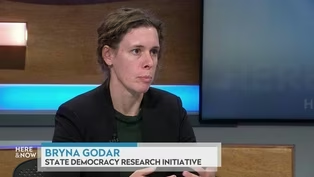
The state Democracy Research initiative at the UW Law School did a deep dive on the ballot.
Questions.
Bryna Godar joins us with more.
Thanks for being here.
>> Thanks for having me.
>> So it seems like a lot of people might reflexively know how they think they're going to vote on these questions, but is it important to consider these kinds of proposed amendments?
>> Yes.
These amendments have implications that can cut across partizan lines.
And so while it might be helpful to look to party leaders to have some indication of how you might want to vote, it's useful to actually look at what the constitutional text itself says.
The first one asks, shall the Constitution be amended to prohibit the governor in exercising his or her partial veto authority from creating or increasing or authorizing the creation or increase of any tax or fee?
Now, it's true.
We know that Wisconsin's governor enjoys kind of the the strongest, most powerful partial veto power in the country and has historically.
Now, this is about Evers 400 year school funding veto.
But are there other examples?
>> Yes.
So Wisconsin governors have taken this broad view of the partial veto power and have used it to strike individual words or letters from budget bills to essentially rewrite provisions.
And we've seen this happen across parties.
Governor Tommy Thompson used this, the so-called Vanna White veto, to strike individual letters to make entirely new words.
Governor Doyle used this, the Frankenstein veto to cut different sentences together and completely rewrite provisions.
And then Governor Scott Walker used it, something similar to what Governor Evers used for the 400 year veto to implement a thousand year moratorium by changing the date from December 31st, 2018 to December 30th, 2018.
>> So what are the implications of this ballot question?
If voters approve it?
>> So this constitutional amendment, if approved, would not actually change that editing power.
It would just mean that the governor cannot use that power to increase a fee or a tax, or authorize the increase of a fee or a tax.
So it'd be more aimed at the purposes for which it's used, rather than the form that the veto takes.
>> All right, let's take a look at the second question.
The second proposes to change the Constitution to prohibit the state or a political subdivision of the state from ordering the closure of or forbidding gatherings in places of worship in response to a state of emergency, including a public health emergency.
This, of course, emanates out of the Covid pandemic, but goes further.
I understand from your research than other states to protect places of worship.
How so?
>> Yeah.
So a number of states have enacted laws in the wake of the Covid pandemic to make sure that places of worship and religious gatherings are not subject to more stringent standards than other locations like restaurants or bars.
But those are typically enacted via statute, which means that they are easier to change in the event of an emergency than a constitutional amendment.
Additionally, they tend to try to put places of worship on the same footing as other institutions, or require the state to have a particularly good reason for imposing the requirements.
And it's not clear if Wisconsin's proposed amendment would go sort of further in protecting places of worship compared to other locations.
>> Because aren't there already protections in for places of worship during emergencies in Wisconsin?
>> Yes.
And the Wisconsin Constitution does already have a religious freedom provision.
And there are also protections under the federal Constitution in the First Amendment for places of worship.
>> So the third question would create a section to prohibit governmental entities in the state from discriminating against or granting preferential treatment to any individual or group on the basis of race, sex, color, ethnicity or national origin.
In public employment.
And now this is about restricting DEI programs.
What are the two sides of this?
>> So proponents of this amendment are critical of affirmative action programs and DEI programs that go beyond affirmative action and argue really for sort of fairness and merit grounds for treating people under without taking into account past discrimination.
There are also arguments that the current DEI programs are themselves discriminatory.
Opponents, however, point to the fact that these programs are typically aimed at remedying past or ongoing discrimination and also how broadly this amendment might sweep in terms of what programs it would invalidate.
>> Because this movement against DEI is part of a national push with real consequences, like what we saw at the UW system.
Is it your belief that this amendment would result in more sweeping changes?
>> It potentially.
It seems like it would.
It depends on how a number of the terms are construed.
It might be something where we see organizations or the university try to comply in advance of a court ruling, but there is a lot that would remain to be fleshed out in court, and also to flush out the nondiscrimination provisions, because this would include an explicit prohibition on discrimination for things like race and sex, and that would also remain to be seen.
What the implications of that would be.
>> So overall, why enshrine such matters in the Constitution rather than in statute?
>> One reason can be because the Republican legislature and the Democratic governor might not agree on how to do things via statute.
And so sending it to the voters is a way for the Republican legislature to get bills through without having to go or get changes through, without having to go through the governor.
Other times, you know, something like equality or other issues are things that voters might want to have in the constitutional amendment, in the Constitution in a way future administrations.
>> How hard is it to change?
>> It takes a legislature passing a constitutional amendment in two successive sessions, and then the amendment needs to go to the voters for approval.
So it is a rather lengthy process to change the Constitution.
And that makes deciding on whether to implement these amendments important to think about what it would take to unwind them if voters disagreed with them in the future.
>> All right.
Bryna Godar, thank you very much.
>> Thank you.
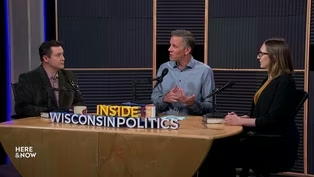
>> This week on Inside Wisconsin Politics reporters, take a look back into the political records for Tom Tiffany and David Crowley, and how those records are informing their campaigns today.
>> One thing I remember about Tom Tiffany in this time, Zac, was that he was kind of a details guy.
Like, you know, there were some lawmakers you can go up to and you ask them about their bill.
They say, talk to my staff.
Tom Tiffany knew the bill.
He also was not afraid to mix it up in the legislature with Democrats.
He was not exactly the get along guy that you see in those ads.
>> Not at all.
And I think Tom Tiffany came into office seeking to oust a Democrat in that seat.
He came in, he rode that Tea Party wave.
And then when it was gerrymandered to make his seat safe, that was the beginning of when the Northwoods went from purplish blue to very, very red.
And he represented that district all the way from the Assembly to the state Senate to Congress.
But he did not rule with the idea of, let's find consensus.
The idea of bipartisanship back in the Walker era, from Republican point of view, was if Democrats want to vote for our bill, great.
It's bipartisan.
If you don't, that's fine.
We're going to pass it anyway because we have the numbers.
And that's the way he has legislated all the way through.
Tiffany present himself when he talks about what he's done in the state legislature and in Congress?
>> Yeah, he points to this kind of lengthy record.
But as you say, he is a details guy.
He really has a kind of clear understanding of the types of policies that he would sort of support as governor.
And of course, I have to put on my sort of separation of powers hat and remind people that governors don't enact policy, but you can kind of see like the values that they might espouse from the bully pulpit, for example.
And so he really kind of points to a lot of those victories, especially, I think, on sort of fiscal conservatism and the way that he would be a responsible steward of of state money.
But he also, I think because he does have to appeal to a wider electorate, he is running at a time that Donald Trump is sort of uniquely unpopular.
There was a little bit more kind of modulation on certain points.
So, for example, certain issues, you know, calling for task forces, let's study it more.
So not necessarily taking such a such a fiery approach.
And then certain things like he voted for a much stronger limit on abortion while in Congress.
But he told me that he would support Wisconsin's existing 20 week limit.
So things like that where he's not necessarily kind of as firmly the Northwoods conservative that he always has been, although, of course, that is who he is.
And I don't think he's running away from that either.
>> You did our coverage of David Crowley's record also, and big picture.
When you think about David Crowley, for somebody who's just getting to know him, who is he?
When you look at his record?
earlier, a word that keeps coming up, no matter who I talk to, is just that he's very likable.
And I remember talking to a Republican during the primary who said that he imagined Republicans would be sort of glad to see him as a Democrat.
Of all those Democratic contenders in Madison, because he is willing to make deals, he is willing to negotiate, and he really kind of positions himself as a problem solver.
And so part of what is involved in that, especially if you have divided government, is working with people who don't necessarily see eye to eye with you.
And so that's a big part of kind of what he is running on.
So I mentioned this big deal from a couple of years ago, and without getting too wonky, it was essentially about how much money Madison sends to different communities.
But Milwaukee was like the big bargaining chip in many different ways, right?
Many parts of Wisconsin don't like Milwaukee.
Milwaukee is also the largest kind of like provider of funds to the state.
>> It's easy to run against Milwaukee in a statewide election if you're a Republican.
Republicans to sign off on a tax raise without going to referendum, which they did not initially want to do.
That is a big sort of victory that he can say, look how I can kind of work across the aisle, work across state lines, deliver for Milwaukee, for Milwaukee County, which is more, you know, diverse suburban and urban.
And I can deliver for the state of Wisconsin.
>> Yeah, Zac, I remember when that happened.
I couldn't believe that Republicans kind of went along with letting Milwaukee raise its sales tax.
It had been a priority of the business community there.
So it's not just like Democratic legislators or mayors.
County executives wanted to do it.
Still a big deal.
And kind of his claim to fame in a way.
And yet here we find ourselves in a general election and he has this big tax increase on his record.
And how is that coming out in the campaign?
>> Well, he's definitely not running on the tax increase.
He's running on the bipartisan compromise, whereas the Republicans are attacking him on the tax increase.
And they don't want to talk about the bipartisan compromise.
They don't want to acknowledge the fact that Speaker Robin Vos was the one that helped push this through.
And it was Republican votes in both houses that got it done, because that doesn't fit their campaign against him.
But the only way for David Crowley to do something like that was to engage Republicans and say, what can you get?
What can we get?
What can we accomplish together?
And so it's just a complete contrast between how the two parties had to try and do anything if they wanted to claim a victory in this very partisan era, where Republicans had complete control of the legislature and ultimately complete control over whatever came to the floor.
>> What are the most important issues to voters?
The Marquette Law School poll consistently shows cost of living as number one.
Immigration.
Number two, and health care as the number three top issue.
There's a lot driving the cost of health care for consumers, including reduced subsidies, new rules and loss of generous plans.
But there's something else that makes Wisconsin a national outlier for how expensive health care is in this state.
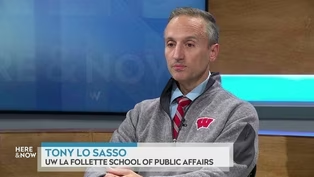
We're joined now by Toni Lo Sasso, a health care economist with the La Follette School of Public Affairs.
And thanks very much for being here.
>> Great to be with you.
>> So how does Wisconsin compare cost wise for health care and attendant kind of premiums and out-of-pocket costs?
>> Yeah, it's a great question.
And it's one of the motivations for my work.
I, I, I am born and raised in Illinois, but I, and a lot of folks in Wisconsin like to dunk on Illinois for a lot of good reasons.
But one of the things I wanted to study is, well, how do health care prices compare between Wisconsin and Illinois?
And sure enough, kind of.
To my own surprise, Wisconsin is is dramatically more expensive when it comes to the cost of health care.
When we talk about hospital prices for health care services, 25% higher.
So than Illinois.
And, and so I think that that's a puzzle for me because it looks as if Wisconsin's actually a pretty.
At first glance, the insurance market looks pretty competitive.
The hospital market, if you take a statewide lens and look at it, it looks pretty competitive.
And so what I did most recently in a follow on study is to drill down into health care markets where people basically where people live and where they see care.
And then you see kind of a different story, a different pattern emerges.
And so here you see that actually hospital markets are quite consolidated.
So what we did in this most recent study is look at how consolidation has, has, has changed in the past 7 or 8 years.
And sure enough, it started out pretty consolidated and it only got more consolidated.
>> Are there any policy prescriptions for this?
>> Yeah, it's really hard.
I mean, there have been a number of mergers.
Some of them have had quite dramatic effects on concentration in specific markets.
I think the the Ascension merger, the merger that took place up in Wausau created basically a not a monopoly, but but a very consolidated, very concentrated market in the Wausau region.
And so and there have been a series of mergers, all of them to the best of my ability to discern, have not been challenged, were not challenged in any way.
So they've gone through.
So that means the FTC at the federal level, that means the state AG.
No, they've gone through so, so so on the one hand, in terms of what do you do now that you're in this situation?
You've got high prices, those prices, incidentally, they they transfer on to higher cost of health insurance.
They go directly into the cost that premiums, the costs that people pay in terms of their health insurance premiums.
So you kind of can't put the toothpaste back in the tube, so to speak.
But you know what I would say from a policy standpoint is you'd like to see people talk about encouraging investment and entry of new hospitals into the market.
It's hard to do, but that's that's a it's hard to it's much harder to unwind mergers.
That's just years of litigation.
>> Meanwhile, how do these costs for health care put a drag on wages in Wisconsin?
>> Yeah, I think that's that's something I, I liken it I like to describe it as, you know, the this increase in health insurance premiums is essentially a silent thief of workers wages.
And I think that's, you know, when you talk about affordability, when you talk about, you know, cost of living, when you've got this, this kind of sneaky drag on people's cash wages, that just amplifies this affordability crisis that we hear so much about.
>> Why does no one on the campaign trail kind of talk about this particular issue?
>> It's a great question.
I mean, people talk about health care generally, but when it comes down to the specifics and what do you do?
How do you how do you tackle this?
It it's challenging.
And I don't think it lends itself all that readily to soundbites.
I mean, the soundbite that you get is Medicare for all.
And that's not really a solution.
That's practical, especially at a state level.
I mean, it sounds like a great bumper sticker, but in terms of actually operationalizing that, nobody, nobody, nobody really wants to see their taxes go up 20, 30, 40% in order to pay for such a system.
So, so I think the solutions are local.
And, you know, I talk about it earlier, like investment.
I think keeping a close eye on any future mergers.
I also think my experience has been that folks in Wisconsin don't even they're not all that aware of how pricey this market is.
It's an outlier nationally.
I'm talking Wisconsin, but nationally it's an outlier.
>> Great.
All right.
Toni Lo Sasso, thank you so much.
>> You're welcome.
>> Prediction markets are continuing to grow in popularity expanding outside of sports betting and into politics.
At its most basic, a prediction market allows peer to peer wagers on the likelihood of any kind of event happening.
And as these platforms like Kalshi and Polymarket grow, experts are weighing the pros and cons of aggregate betting on elections.
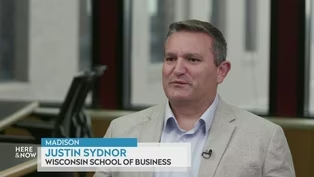
Producer Marissa Wojcik sat down with Justin Sydnor, a Wisconsin School of Business professor specializing in risk management.
For Moore.
We should note in Wisconsin, it is illegal to bet on an election.
You are voting in.
>> These have been around for a while before recently exploding.
>> Yeah.
So, you know, they date back decades.
Actually, one of the first ones started in Iowa actually as kind of an academic thing where they were trying to predict election outcomes.
So they've been around for a very long time.
They've been studied by academics, but they've really exploded in popularity in the last two years with the advent of listing sports contracts, basically sports betting enabled on these markets.
>> However, now that sports has popularized it, it's now blending back into other world events.
>> Yeah.
So, you know, they've these sort of markets have long existed to let you bet on elections or economic outcomes.
Other political movements.
But I think because of sports betting making them so popular, they've brought in a lot of people who participate on these markets, who now also place some bets on things other than sports that they might not have bet on historically.
And so what that means is that a lot of things like elections have much bigger market volume than they ever historically did.
So it's much more possible to make a lot of trades and potentially have a lot of money at stake on these outcomes in a way that wasn't true even a couple of years ago.
>> Is it dangerous for a Polymarket to be weighing in on elections?
>> I think it's it's not necessarily dangerous, but you need to interpret it through the lens of the market that basically there's a price and it's based on what people think and are willing to place their bets behind at any given point in time.
And that price and those beliefs can change.
And so there's nothing locked into stone and there's no magic sauce to it.
You don't really have a crystal ball.
What you have is a way of aggregating what a bunch of people happen to think at that moment in time.
>> Is it possible for more nefarious actors to manipulate the market to achieve potentially a better outcome for a candidate?
>> Yeah.
>> So, you know, I don't think we have to worry hugely about manipulating the prices in most of these markets.
So as particularly in markets that lots of people are placing bets in and following to move the price in the market.
So move people's beliefs in the market, likelihood of an outcome happening.
You really have to put a lot of money at stake.
So you're going to have to buy a ton of contracts on your favorite candidate.
If you want to move that price.
And ultimately, it's a pretty expensive and risky thing to do because if they don't end up winning, you're going to lose that money over time.
And so I don't think that's the major risk.
But I think the bigger risks are that there's risks of insider trading information.
So if you're participating in these markets, you really have to worry what people on the other side of the bet may know that you can't know.
And we have seen some really high profile cases of insider trading.
I think we also have to worry a little bit that these markets create incentives, potentially for people to try to manipulate the real outcomes of things.
So when you have betting markets behind events that aren't just random events that are going to happen one way or another, but where somebody or some entity could control the outcome, you now may be amplifying the incentives to manipulate those outcomes.
>> And because it's a market, it's always moving forward and changing.
And so it's different than a poll.
>> Yes.
So, you know, it's somewhat similar to polls in the fact that, you know, if you think about polling for any election, we tend to conduct many polls over time because we recognize that news come out, sentiment changes.
And, you know, there are lags in polls.
What mark, what these prediction markets have as an advantage potentially, is that they can react much more quickly to news.
So as an information source about what people are thinking and how important various events or news items were, they can be more informative because they do change minute by minute.
The price on these markets is moving.
>> And is there a chance that they're more accurate because potentially more people are weighing in and they have to put money behind what they're saying?
>> Yeah.
So there's, you know, some good research suggesting that relative to some other ways of trying to forecast the likelihood of uncertain events, that there are some attractive features of these markets and that on average, they can often be a little bit more accurate than some other techniques, and certainly more accurate than typically any one individual's estimate might be.
You know, they benefit from leveraging the information of a lot of people.
And so biases tend to get somewhat muted by lots of people participating.
And the betting feature, the putting money behind the those, those predictions, if you will, does put extra weight for people who are more confident in the outcome.
Now, whether that leads to accuracy really kind of depends whether those confident bettors, the people willing to put their money behind, have better information and better insight about what's going to happen.
I think sometimes that's true.
Other times these markets, you know, there's just not good information out there.
And in those instances, there's no reason to believe that they're going to be particularly good at making an accurate likelihood assessment.
>> Well, thank you so much.
>> Thanks.
Thanks for having.
>> Me.
>> On November 3rd, joined Shawn Johnson and me for live election coverage on Wisconsin Public Radio.
We'll also be live streaming on our websites, YouTube and Facebook, all starting at 815.
After the polls close.
For more stories and issues facing Wisconsin, visit our website at PBS wisconsin.org and then click on the news tab.
That's our program for tonight.
I'm Frederica Freyberg.
Have a good weekend.
>> Funding for "Here& Now" is provided by the Focus Fund for Journalism and friends of PBS Wisconsin.
 New
NewBryna Godar on Wisconsin's Proposed State Amendments in 2026
Video has Closed Captions
Clip: S2500 Ep2516 | 6m 41s | Bryna Godar on three proposed state constitutional amendments that voters will decide on. (6m 41s)
 New
NewElection Denial and Wisconsin's 2026 Races for Governor, AG
Video has Closed Captions
Clip: S2500 Ep2516 | 6m 15s | Candidates speak to a push by President Donald Trump in administering the midterms. (6m 15s)
 New
NewHere & Now opening for October 16, 2026
Video has Closed Captions
Clip: S2500 Ep2516 | 1m 12s | The introduction to the October 16, 2026 episode of Here & Now. (1m 12s)
 New
NewInside Wisconsin Politics: Crowley's and Tiffany's Records
Video has Closed Captions
Clip: S2500 Ep2516 | 5m 23s | Inside Wisconsin Politics on the political records of the candidates for governor. (5m 23s)
 New
NewJustin Sydnor on Prediction Markets, Politics and Elections
Video has Closed Captions
Clip: S2500 Ep2516 | 5m 50s | Justin Sydnor on the growth of prediction markets to place bets on elections and politics. (5m 50s)
 New
NewMcCoshen & Ross on Wisconsin's 2026 Midterm Election Outlook
Video has Closed Captions
Clip: S2500 Ep2516 | 8m 10s | Bill McCoshen and Scot Ross on races for governor, the state Legislature and Congress. (8m 10s)
 New
NewTony Lo Sasso on Healthcare Costs as a Top Issue for Voters
Video has Closed Captions
Clip: S2500 Ep2516 | 5m 45s | Tony Lo Sasso on how the issue of healthcare is shaped by mergers and rising premiums. (5m 45s)
 New
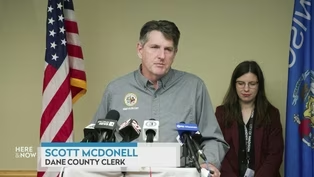
NewWisconsin Clerk Asks Absentee Voters to Hand-Deliver Ballot
Video has Closed Captions
Clip: S2500 Ep2516 | 1m 45s | Scott McDonell urges voters to take their absentee ballot to a drop box or clerk's office. (1m 45s)
 New
NewWisconsin Elections Officials Invest in Safety and Security
Video has Closed Captions
Clip: S2500 Ep2516 | 1m 38s | Meagan Wolfe outlined the state's election security preparations in 2026. (1m 38s)
 New
NewLisa Tollefson on Oversight of Wisconsin's 2026 Elections
Video has Closed Captions
Clip: S2500 Ep2516 | 5m 31s | Lisa Tollefson on local administration of the November 2026 election in Wisconsin. (5m 31s)
 New
NewWhat Are the Top Issues in Wisconsin's 2026 Election for AG?
Video has Closed Captions
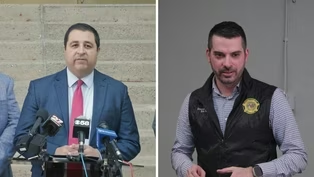
Clip: S2500 Ep2516 | 7m 28s | Josh Kaul and Eric Toney speak to state crime labs, abortion law and federal lawsuits. (7m 28s)
Providing Support for PBS.org
Learn Moreabout PBS online sponsorship New Episode
- News and Public Affairs

Top journalists deliver compelling original analysis of the hour's headlines.
 New Episode
- News and Public Affairs

Today's top journalists discuss Washington's current political events and public affairs.
 New Episode
 New Episode
 New Episode
 New Episode


 New Episode
 New Episode

Support for PBS provided by:
Here and Now is a local public television program presented by PBS Wisconsin